| |
[ excerpt ]

also by the author:
Glorious Nemesis
A Postmortem Dream
Visions & Apparitions
|
|
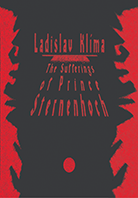
the sufferings of prince sternenhoch
A Grotesque Romanetto
by Ladislav Klíma
translated from the Czech by Carleton Bulkin
illustrations by Jan Konůpek
afterword by Josef Zumr
Philosopher, novelist, essayist, eccentric, no other Czech author has had a greater impact on underground culture than Ladislav Klíma (1878-1928).
Mentor to artists as varied as Bohumil Hrabal and the Plastic People of the Universe, Klíma’s philosophy was radically subjectivist, and he felt
it should be lived rather than merely spoken or written about. With Nietzsche as his paragon, he embarked upon a lifelong pursuit to become God,
or Absolute Will, elucidating this quest in many letters, aphorisms, and essays. Yet among Klíma's fictional texts, the apotheosis of his philosophy
is The Sufferings of Prince Sternenhoch, his most acclaimed novel. Ostensibly a series of journal entries, the tale chronicles the descent
into madness of Prince Sternenhoch, the German Empire’s foremost aristocrat and favorite of Kaiser “Willy.” Having become the “lowliest worm” at the
hands of his estranged wife, Helga, the Queen of Hells, Sternenhoch eventually attains an ultimate state of blissmand salvation through the most grotesque
perversions. Klíma explores here the paradoxical nature of pure spirituality with a humor that is as dark as it is obscene. This volume
also includes his notorious text “My Autobiography.”

The non-conformist work of Ladislav Klíma has almost always shocked, has often incited scandal, but has hardly ever left us indifferent.
One need not accept his view of the world to experience it and enjoy it in all of its ambiguity, just as one does the stage. |
— Václav Havel
|
Sternenhoch’s instability is excellently demonstrated in his inability to hold one topic for longer than a couple of sentences, his consistent pauses in the
middle of utterance. It’s graphorrhea before we even knew graphorrhea existed, and its retention is critical to our understanding of Sternenhoch’s madness. |
— Amy Riddell, Bookmunch
|
Sternenhoch's antics are by turns depraved and dark, and hugely comical ... Klima's vast talent is more than capable of
handling the task of chronicling Sternenhoch's descent into madness. |
— Damian Kelleher, Neon
|
What I do want to acknowledge before I conclude is just how readable, how relentlessly entertaining, I found all this to be. |
— Books, Yo
|
The grotesque and the sublime, the extravagant and the playful, run through this novel breathlessly written by a philosopher who wanted to recover his health. |
— Le Monde
|
As a story of one man's madness, this work is up there with Dostoevsky and Kafka, though with a bitter sense of humor and
absurdist, almost maniacal outlook on life. |
— The Modern Novel
|
It is a classic darkly comic and obscenely funny piece of writing, — not for everyone
but a wild excursion indeed. True black humor. |
— edgylit
|
The philosopher-writer is rightly included in the Czech canon. He had great influence on writers like Hrabal and writer-artist Jiri Kolar.
Klíma was a pathological, but radical and intelligent man. He absolutely knew what writing is. |
— peekaboo
|
Ladislav Klima's The Sufferings of Prince Sternenhoch: A Grotesque Tale of Horror delivers on its title.
It has everything; a decadent noble of questionable intelligence and sanity; a twisted, depraved, satanic shrew; not so graphic
lewdness; dungeons, murder, madness... It is frankly, at times, difficult to stomach; and I have read The 120 Days of Sodom —
more than once. |
— Adventures in Nerdliness!
|
The Sufferings of Prince Sternenhoch may transmit the author's moral nihilism and Nietzschean will to power as well as any treatise. It is a hilarious, provocative, graphic — and at times
spectacularly vile — gothic novel, conspicuously rooted in the Decadent milieu that spawned it, but painted in colors more characteristic of the Expressionist and Surrealist movements regnant when it
was finally published two decades later. ... Klíma's entry since then into the Czech canon, to say nothing of his importance to artists as varied as Bohumil Hrabal, Jiri Kolar and the Plastic People
of the Universe, more than warrants the scrupulous care that Bulkin and Twisted Spoon have dedicated to this welcome translation. |
— Slavic and East European Journal
|
Klíma's tale reads like a book that Edgar Allan Poe might have written if he'd read Nietzsche, but there are
also moments of reverie that are pure Czech ... Klíma's rambunctious mix of high and low style and holy and profane
content has been stamped indelibly on the Czech literary tradition. |
— Washington City Paper
|
There's much of the whip in all this, a great fascination with all things perverse ... Much scabrous wit and the
hallucinatory nature of events leave the reader uncertain about taking anything seriously. Appended is the author's
autobiography, in which he turns out to be as pathological as any of his characters, a genuine transgressive in the
manner of de Sade. |
— Publishers Weekly
|
A dark, diverting entertainment, certainly out of the ordinary ... [Klíma] was a decidedly odd bloke, a real character.
But he was not a stupid man, and he could write. This volume is apparently the first book of Klíma's to appear in
English. Certainly he is an author deserving wider recognition in the English-speaking world. |
— The Complete Review
|
Given the power of Carleton Bulkin's excellent translation, I can only hope that Twisted Spoon or some other publisher sees fit to soon translate more of Klíma's works —
fiction or philosophy ... The Sufferings of Prince Sternenhoch runs with gale-force intensity and speed. |
— The Education Digest
|
|
|
 |
|
ISBN 9788086264554
204 pp., 135 x 195 mm
softcover with flaps
4 B&W illus.
fiction : novel + autobiography
cover concept by
Pavel Růt
new edition
release dates:
UK: October 2019
US: December 2019
Order directly:
airmail shipping & handling incl.
also available from:
Wordery
Bookshops
Bookshop.org
Amazon US
Amazon UK
Central Books
e-book
Kindle US
Kindle UK
Kindle Canada
Kindle DE
Kindle India
Kindle Japan
Apple iBooks
Kobo
|