| |
[ excerpt ]
book view

original cover
also by the author:
The Sufferings of
Prince Sternenhoch
A Postmortem Dream
|
|
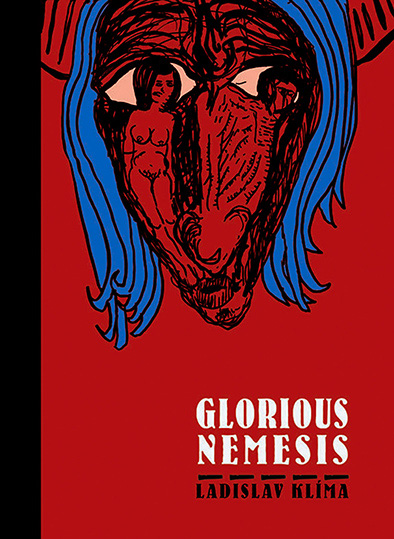
glorious nemesis
by Ladislav Klíma
translated from the Czech by Marek Tomin
cover and illustrations by Pavel Růt
Klíma's intense inner life and complex mental state are reflected in his peculiar writings. His eccentricity of style and often volatile prose were intended to convey the
deep conflicts attending his thought processes, and this is perhaps best exemplified in the novella Glorious Nemesis. Set in the Tyrol, it is a balladic ghost story that
explores the metaphysics of love and death, crime and reincarnation. Sider, a man of twenty-eight, is confronted by a giant mountain named Stag's Head and an ancient
hovel standing under a high, black cliff. Out one day on a hike, he encounters two women who will mark his fate: the elder Errata, dressed in red, and the younger Orea,
dressed in blue (the two colors of the Virgin Mary). From this point on Sider is on a quest for the All, the Absolute, and to achieve eternity by atoning for the
misdeeds of a past life. Willing to risk his entire fortune and sanity, he succumbs to his dreams and hallucinations as Orea, or her doppelgänger, becomes for
him a representation of the goddess Nemesis who initiates him into the mysteries of divine retribution.
Last revised by Klíma in 1926, Glorious Nemesis was published posthumously in 1932. This is the first English translation and includes illustrations from
celebrated Czech book designer Pavel Rut, who produced a samizdat edition of the text (with an earlier set of illustrations) during the 1980s when the
Communist regime prohibited publication of Klima's work. In the 1970s, The Plastic People of the Universe set the novella to music: here.

Ladislav Klíma has been an important "voice calling in the wilderness." His antimetaphysical view of the world
was not unique at his time, as Europe was full of followers of Friedrich Nietzsche, both good and bad. Yet Klíma's mix of philosophical
essay, fiction, poetry, and drama was unique. Often he was too fervent in proclaiming that the only security lies in the awareness of
one's will and of one's absolute freedom. In this way he eliminated the border between truth and fiction, between waking and dreaming,
and even between life and death. If the world, from Klíma's perspective, was to be some phantasm or phantom, we would need a new way of
articulating it, of creating it anew. At the same time, the main purpose of the world would be inherent in the free and unlimited will,
life a game for the free individual. The non-conformist work of Ladislav Klíma has almost always shocked, has often incited scandal,
but has hardly ever left us indifferent. One need not accept his view of the world to experience it and enjoy it in all its ambiguity,
just as one does the stage.
|
— Václav Havel
|
The book’s sustained brutality was perfect ... |
— Garett Stickland, HTML Giant
|
... a fast-paced novella, full of creepiness and mystery, that aims to disrupt every firm distinction we make
between not only the real and the imaginary, but also curiosity and obsession, innocence and guilt, mental health and an
unbalanced mind. [...] questions of harmful actions and their repercussions are never dated; and the febrile mind pushing things
along assures that this remains a literary work that is also a page-turner. |
— Jeff Bursey, The Review of Contemporary Fiction
|
Klima might be termed a gleeful radical and this had as much to with the phraseology used as it did the fundamental tenants of his world view. |
— Daniel Corrick, Sacrum Regnum
|
These sometimes haphazard musings elevate the book beyond a simple Gothic tale, and understanding Klíma’s philosophical leanings does
offer a more layered reading of the text. Conversely, however, it’s a treat to have concepts like these wrapped in such an entertaining package. |
— Holly Zemsta, NewPages
|
Glorious Nemesis is less a novel than an allegory, however, in that it is
largely a vehicle for some of Klíma's more abstract ideas about the soul and fate. |
— Stephan Delbos, The Prague Post
|
Either way, this story has characteristics I associate with other continental weird writers,
most notably the way that real and imagined experience collapse into one another over and over, to the point where reality and fiction become totally
blurred. The flavour is distinctively different from American and English writing of the same period, which often seems reticent by comparison,
determined to re-establish those boundaries. |
— Maureen Kincaid Speller, Weird Fiction Review
|
Glorious Nemesis has all the trademarks of the dark side of Romanticism ... Insanity, crime, doubles, lesbianism, sadomasochism, ghosts and hallucinations
all play a role in the story. The centrality of a massive mountain, by turns beautiful and sinister, also harks back to the Romantic sensibility. Yet like the best writers of this
tradition Klíma is doing much more than telling a ghost story or a tale of a man going insane. |
— Michael Stein, Literalab
|
Being an amalgamation of poetic prose, personal testimony and philosophical treatise, the story within Glorious Nemesis
is easily lost behind the theory. For those searching for an enjoyable story with a feisty narrative, uninterested in Klíma's thought, there is an
amusing little ghost story with an interesting twist, one that will horrify even the most hardened fans of traditional gothic-fare. Equally, it
would not be unfair to categorize the book as pure philosophy, behind which lies a serious monistic debate into the true nature of existence. |
— Richard Jackson, KGB Bar Lit Magazine
|
I feel myself to be walking in the footsteps not only of Jaroslav Hasek, but also Doktor Franz Kafka, in the footsteps of what Ladislav Klíma wrote and stood for ... |
— Bohumil Hrabal
|
Next to Klíma, Diogenes in his barrel was a homeowner. |
— Karel Čapek
|
Both metaphysically and stylistically intriguing, Glorious Nemesis is a work that belongs alongside those by E.T.A. Hoffmann
and his heirs — Meyrink and Leo Perutz (at their most daring), Kubin, and the like. Curious stuff, and very much of its time, it's nevertheless quite
fascinating. |
— The Complete Review
|
There are many striking passages in Glorious Nemesis and not a few obtuse reflections on the human
condition. If a comparison is needed, I'd say that Klima, in Marek Tomin's smooth translation, reminds me of Poe most of all.
It should be said also that Pavel Rut's evocative illustrations enhance the sometimes enigmatic text. One of Klima's admirers
was the late, great Václav Havel. And I too would like to add my humble shilling's worth of admiration to the kitty. |
— Paul Kane, The Compulsive Reader
|
What is unusual is the intensity of Klima's focus on one man and his obsessive vision of a nameless woman who may be
a ghost, a demon or something even stranger. It is always difficult to judge a translation, but I think Marek Tomin has conveyed much of
Klima's strange power. It is also, as I mentioned above, a beautiful book in its own right, with a superb cover and illustrations by
Pavel Rut. |
— Supernatural Tales Blog
|
[T]his book touches many things over its short length philosophy, religion, love and longing, also the Czech
tradition of the ordinary turning into the surreal and absurd ... |
— Winstonsdad's
|
As a young admirer of Ladislav Klíma, I went to Malvazinka Cemetery in Prague to visit his grave on New Year's 1978. The year marked the fiftieth anniversary of his
death and the centennial of his birth, and at midnight I drank a toast of "deoessence" to his memory. Since the ground was covered in snow, I erected a tall brooding
figure on top of his grave slab. As I was leaving I heard something clatter and turned around. An official looking elderly man, bearded, had emerged from behind a tree and
was vigorously kicking the snowman apart. ... Klíma's language is hyperbolic, absolute, and combative because it captures his lifelong battle for his Self and with his
Self. |
— Emil Hakl
|
|
|
 |
|
ISBN 9788086264394
123 pp., 13.5 x 19 cm
hardcover
color frontispiece
4 b/w illustrations
fiction : novella
cover by Pavel Růt
release date:
December 2011
Order directly:
airmail postage & handling incl.
or order from:
Book Depository
Bookshops
Bookshop.org UK
Amazon US
Amazon UK
Amazon Canada
Amazon Germany
Central Books
e-book [978-80-86264-74-5]
Amazon US
Amazon UK
Amazon Canada
Amazon Australia
Amazon Germany
Amazon India
Amazon Japan
Apple iBooks
Kobo
|