| |
[ excerpt ]

also by the author:
Woman in the Plural
A Prague Flâneur
The Absolute Gravedigger
Edition 69
Antilyrik
Original soundtrack
to the film
here and here
DVD here
New film score by
The Valerie Project
|
|
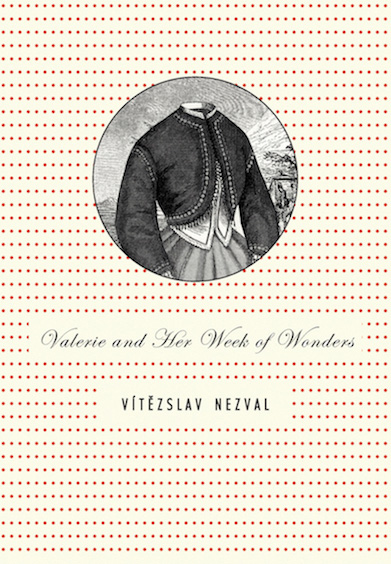
valerie and her week of wonders
by Vítězslav Nezval
translated from the Czech by David Short
illustrated by Kamil Lhoták
afterword by Guiseppe Dierna
Written in 1935 at the height of Czech Surrealism but not published until 1945, Valerie and Her Week of Wonders
is a bizarre erotic fantasy of a young girl's maturation into womanhood on the night of her first menstruation. Referencing Matthew Lewis's The Monk, Marquis de Sade's Justine, K. H. Macha's May,
F. W. Murnau's film Nosferatu, Nezval employs the language of the pulp serial novel to fashion a lyrical,
menacing dream of sexual awakening involving a vampire with an insatiable appetite for chicken blood, changelings,
lecherous priests, a malicious grandmother desiring her lost youth.
In his Foreword Nezval states: "I wrote this novel out of a love of the mystique in those ancient tales, superstitions and romances, printed in Gothic script, which used to flit before my eyes
and declined to convey to me their content." Part fairy tale, part Gothic horror, Valerie and Her Week of Wonders is a meditation on youth and age, sexuality and death, an androgynous merging of
brother with sister, an exploration of the grotesque with the shifting registers of language, mood, and genre that were a hallmark of the Czech
avant-garde. The 1970 film version is considered one of the outstanding achievements of Czech new-wave cinema.
This edition includes Kamil Lhoták's original illustrations.

We can read this book several ways. Firstly, it is a Gothic novel but, secondly, it is a Gothic novel written by a surrealist, so all sorts of mysterious, magical
and unreal events take place. Thirdly, it is clearly intended, at least in part, to be a spoof of the traditional Gothic novel. Indeed, if you do not take it too seriously, you
will find it great fun to read, not least because whenever our hero or heroine are in trouble, you know they will be rescued by the other or by some mysterious force. In addition.
a whole host of improbable events take place.
|
— The Modern Novel
|
...it is certainly the case that the ‘wonders’ element of the novel is its most immediately appealing feature. Indeed, were I attempting to convince someone to read
the book I would, without question, mention the vampire polecat; the plot to steal a boy’s heart and transplant it into another; the hanging, the accusations of witchery, the
despairing crowing of a cock, the burial ground, the ghost. In relation to this, Nezval himself wrote in his foreword that his work is ‘bordering on the ridiculous’, and there is,
as far as I am concerned, no greater selling point than that. |
— Books, Yo
|
The book is a tour de force in that Nezval adopts the genre of the pulp novel for his own arch purposes.
Have literary historians noticed that it is a precursor of some of our own aesthetic concerns, in other words a sort of pre-postmodern fantasy? |
— John Taylor, The Antioch Review
|
Gothic sleazefest, menstrual fantasy, dime-store pulp fiction—Valerie and Her Week
of Wonders is a collage of a collage of a collage, a dream of a dream, an important early-century surrealist
novel only now translated from its native Czech into English by the able David Short. |
— New York Press
|
The work is a fantastic romp through a field of surreal visions and juxtaposed imagery. ...
David Short's translation maintains an excellent rhythm throughout the novel. |
— Slavic and East European Journal
|
Valerie and Her Week of Wonders reclaims the irrational from its exiled
state through the use of hybrid form and surreal content. The text enables us to dream about what
it might be like to be more than our fears, limitations, and distractions by calling into question
our personal limits. David Short's beautiful translation reminds us that dealing with meaning in
the contemporary world is a very funny and always disturbing adventure — one that may help us live
more bravely if we are willing to dance with the unfamiliar. |
—Selah Saterstrom, American Book Review
|
Somewhere between the existential fables of Franz Kafka and the macabre
animations of Jan Švankmajer lies Vítězslav Nezval. Valerie and Her Week of Wonders
reminded me of a hyperactive Hammer Horror film as directed by Luis Buñuel. |
— The Absinthe Literary Review
|
A real curiosity: a surrealist novel masquerading as a gothic thriller ... a rare book that exists in its own indefinable
category. ... This makes for a pulpy tale that reads like something else entirely; what that something is I'm not entirely sure, but it's
rich, thoughtful and profoundly strange. |
— Fright Site
|
|
|
 |
|
ISBN 9788086264196
226 pp., 135 x 190 mm
softcover with flaps
6 b/w illustrations
fiction • novel • surrealism
publication:
June 2005
order directly via PayPal:
airmail postage & handling incl.
Note: U.S. price also includes
customs ID processing fee
also available from:
Bookshops
Bookshop.org
Shakespeare & Sons
Blackwell's
Waterstones
Wordery
Amazon US
Amazon UK
Central Books
e-book [978-80-86264-69-1]
Amazon US
Amazon UK
Amazon Canada
Amazon Australia
Amazon Germany
Amazon India
Amazon Japan
Apple iBooks
Kobo
|