| |
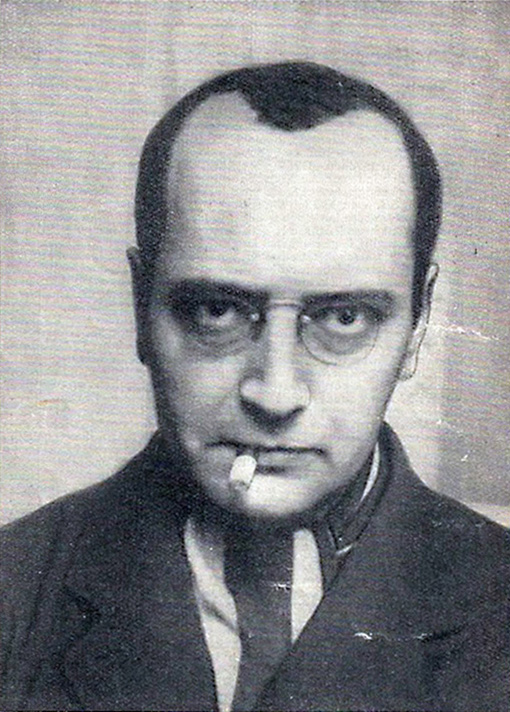
More Serner images here
Read:
"The Clincher Box"
"The Hole in the Vest"
automatic poems
Walter Serner Society
[in German]
|
|
walter serner
Walter Serner was born into a Jewish family as Walter Eduard Seligmann on January 15, 1889, in the Bohemian spa town of Karlovy Vary (Karlsbad at that time).
His father, Berthold Seligmann, owned the town's major newspaper, the Karlsbader Zeitung, for which Walter wrote an arts column. In 1909, he graduated from the gymnasium in Kadan, which was
attended by many Jewish students from the region, and soon thereafter matriculated at the University of Vienna's Law Faculty, formally converting to
Catholicism and changing his name to Serner. In 1911, he organized in Karlovy Vary's Café Park Schönbrunn a large exhibition of Oskar Kokoschka's work.
Serner quit school and left for Berlin in 1912 where he became a contributing writer for the avant-garde magazine Die Aktion and associated with anarchists. He ultimately
finished his law degree at the University of Greifswald.
A staunch pacifist, with the outbreak of WWI Serner left for Switzerland and ended up in Zurich co-editing with Hugo Ball and Emmy
Hennings the magazine Der Mistral (where under the name Wladimir Senakowski he published his first prose). A founding member of Dada, he mostly eschewed participating in
the Cabaret Voltaire evenings, claiming that "theater corrupts my game," though at least on one legendary occasion he so antagonized the audience that pandemonium erupted. According to Hans Richter,
Serner was "the great cynic of the movement, the total anarchist, an Archimedes who put the world out of whack and then left it to hang." And for Christian Schad, it was Serner
who "fertilized Dada with ideas, who gave Dada its ideology." What were these ideas? That idealism was a con, that fixed identity was a danger to be avoided, and that
boredom was at the root of everything: "The world is boring, a fact as undeniable as it is unfathomable. Since no one can bear boredom, people are easily enthralled
by spectacle, and for that reason are ever so ready to head off to war." In Zurich, Serner became acquainted with Lenin, and remarked after the October Revolution:
"Every revolution is desire's revolt for a more beloved fist."
Active as well in Bern and Geneva (he was in a sense "Geneva Dada"), Serner established the literature and
arts monthly Sirius and contributed many of the texts. In 1918 in Lugano, he wrote the first version of Letzte Lockerung his infamous Dada Manifesto,
much of which, rumor has it, was later plagiarized by Tristan Tzara for his Dada Manifesto. Fed up with the careerism of the artists drawn to Dada, whom he saw as "caged in their own intellect,"
he distanced himself from the movement and focused on writing. His first volume of crime stories appeared, and in 1920 he met with Breton in Paris, broke with Tzara, and now with a Czechoslovakian
passport headed to Naples to join Christian Schad. By 1921 he was back in Germany and working on his novel The Tigress, which came out in 1925 in Berlin, as well as publishing more volumes of short crime stories, but now not with his former
publisher Steegeman, who became so angered that he published a letter in the Prager Tagblatt calling Serner an "international con man," a "pimp"
and "whorehouse proprietor."
Serner was constantly on the move, turning up at various points around Europe for the rest of the decade, and Zurich officials registered 34 different addresses for him between
1915 and 1933. What he lived on, no one knew, but he did have a rich benefactor in Dutch millionaire Anton van Hoboken, to whom Last Loosening is dedicated. He seemed to
drop out of sight, lending further credence to the myth that he had become part of the criminal underworld. But he had returned to Czechoslovakia, married his longtime girlfriend from
Berlin, Dorothea Herz, and lived the quiet life of a schoolteacher in Prague (first at Revoluční 30 and then Kolkovna 5). The Nazis
banned and burned his books once they took power, and when the Reich eventually occupied Bohemia and Moravia and established the Protectorate,
Serner and his wife made numerous futile attempts to leave the country for Shanghai. On August 10, 1942,
they were deported to the Terezín concentration camp and ten days later, on August 20, put on transport No. Bb headed to Riga. Along with the other
deportees they were murdered in the Bikernieki Forest in Latvia and buried in a mass grave.
Hans Richter noted: "Serner was so naïve as to think he could find sympathizers in the world of art. After turning his back on the art world — the very art
world that would later use his ideas like a brand of laundry detergent — he glorified a world of swindlers in which everyone is engaged in deception."
Hans Arp, who wrote automatic poems with Serner and Tristan Tzara, described him in this way: "Serner loved adventure and, as might befit an adventurer,
has long since disappeared. No one knows what actually became of him, not even his friend Christian Schad, who also worked on the final Dada
publications. Serner reminded me of a swallow. He loved people that made their way on unstable paths through life, smiling dandies, modern misfits.
He loved trapezes, mirages, echoes, synthetic mushrooms, and manicured and pedicured Sterne, or, stars. Occasionally, he rushed up stairs as if he were
rushing to the rooftop to discreetly watch the hanging of a judge. He had the gait of a high-wire artist proudly hopping across the safety net to the
thunderous applause of the audience, before dancing off with a light step.”
|
|
 |
|
published by TSP:
Last Loosening
The Tigress
The Eleventh Finger [forthcoming]
|