| |
[ excerpt ]
book view

additional reading:
Statement by the
Czech Surrealists
The Mácha Cult
by Bohuslav Brouk
A conversation with
the translator here
events:
|
|
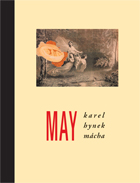
may
by Karel Hynek Mácha
translated from Czech and introduced
by Marcela Malek Sulak
drawings by Jindřich Štyrský
Often compared to Byron, Keats, Shelley, and Poe, called Lautreamont's "elder brother" by the Czech Surrealists,
Karel Hynek Mácha (1810-1836) was the greatest Czech Romantic poet, and arguably the most influential of any poet
in the language. May, his epic masterpiece, was published in April 1836, just seven months before his death.
Considered the "pearl" of Czech poetry, it is a tale of seduction, revenge, and patricide. A paean as well to nature,
the beauty of its music and its innovative use of language, expertly captured in this new translation by Marcela Sulak,
has ensured the poem's lasting popularity. Scorned at first by the national revivalists of the 19th century
for being "un-Czech," Mácha was held up as a "national" poet by later generations, a fate which the interwar Czech
avant-garde, who considered him a precursor, took it upon themselves to reverse.
Unlike the other seminal 19th-century European poets, Mácha's work has been largely ignored in English translation.
The present volume, the only available in English, provides the original Czech text in parallel and includes a
series of illustrations by Jindřich Štyrský specifically created for the poem.

There are many literary works that risk being ruined for readers simply
because they are prescribed study in school, often presented in a rote manner that leaves its
victims, er students, with few fond memories. No doubt, for generations of Czech students,
Karel Hynek Mácha’s epic poem May might be remembered primarily as something they were
required to read in school, old fashioned and difficult. But to come to this poem well
into adulthood, without school-deadened experience and as someone whose first poetic passion
was English Romantic poetry, this tale of romance, betrayal, patricide and brutal punishment
is fascinating, as is the short, tragic life of its author. |
— Joseph Schreiber, roughghosts
|
This seems to be the first English version in more than 50 years of the greatest
poem by the premier romantic poet of the Czech language. Macha (1810-36) published his masterpiece at
his own expense shortly before he died, probably of cholera. Mostly in tetrameters, with expansive
sections in longer lines, the poem pioneered iambs in Czech, in which dactyls and trochees work more
easily, and is famously melodious. It is prefaced by a rather crude patriotic paean that is Macha's
acknowledgment of his era's call for patriotism in Czech literature, which he otherwise ignores in
favor of international romanticism. The poem portrays a young woman pining for her lover condemned to
death, his last hours and execution, nature's lament for him, and the poet's recollection of the
lovers' legend. Byron, or Keats, well could have written it, and if translator Sulak declines to
slavishly render its rhymes (observable on left-hand pages in this bilingual edition), she convincingly
echoes its meters and movingly conveys its various beauties. |
— Ray Olson, Booklist
|
Many works of art and literature are beloved because they are linked inextricably to the culture and age from
which they sprang. Consider Norman Rockwell. But truly great works often seem to appear from nowhere, as if they've had no predecessor.
Mácha's "May" seems to fit both categories: Stylistically, it has no real precedent in Czech literature, and yet over the past two
centuries it has taken a central place in the hearts and minds of [Czechs] as the crowning achievement of Czech Romanticism. That
fact is reason enough to read the poem. Marcela Sulak's skillful, sensitive translation of Mácha's groundbreaking language is another.
|
— Stephan Delbos, The Prague Post
|
To my mind the most modern Czech poem is K.H. Macha's May. |
— Jindrich Styrsky
|
Marcela Sulak has beautifully maintained the same style of poetic language as Macha, with the use
of the dash to represent silence and time lapse. Sulak's Introduction is also informative for the non-reader of Czech and fairly
explains the difficulties in maintaining a true English parallel to the original. |
— Slavic and East European Journal
|
|
|
 |
|
ISBN 9788086264226
121 pp., 14.5 x 19 cm, hardcover
4 pen-and-ink drawings
single poem, bilingual
release date:
November 2005
Order directly via PayPal
price includes airmail worldwide
$20
or order from:
Book Depository
Bookshops
Indiebound
Bookshop.org
Bookshop.org UK
Amazon US
Amazon UK
Central Books
e-book [978-80-86264-90-5]
Amazon US
Amazon UK
Amazon Canada
Amazon Australia
Amazon India
Amazon Germany
Amazon Japan
Apple iBooks
Kobo
|