| |
[ excerpt ]

author events:
|
|
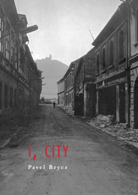
i, city
by Pavel Brycz
translated from the Czech by
Joshua Cohen & Markéta Hofmeisterová
I, City is a novel about the city of Most in north Bohemia, an ancient city founded on a primeval wetland
that was literally "relocated" to get to the brown coal beneath it. The city is the narrator, telling its own
story through its inhabitants, who make their "appearances" in fleeting, ghost-like vignettes, Joycean epiphanies
straight out of a Bohemian Dubliners. The "I" that purports to be Most seems to be an entire consciousness,
at enough of a remove from the town itself that he, she or it can see and can know seemingly everything, past and
present. As Most's inhabitants emerge from the pollution, or from the swamp of the town's founding, we find not
individuals but representatives. Theirs are historical lives that mistrust history, or that live it at least with
typical Czech irony. This abstraction, Brycz's making of archetypes, isn't accomplished in a spirit of abuse. Brycz
obviously loves his "small" people, and has more than sympathy—he is one of them. As Brycz makes fictional people
say factual things and factual people (Kafka, the Pope, the last president of Communist Czechoslovakia, Gustáv Husák)
say fictional things, post-modernity via Marquez and other so-called Magical Realists makes its almost
requisite—though noiseless—appearance.
Awarded the prestigious Jiří Orten Prize in 1999, I, City is many things: a novel-in-stories, a series of lyrical prose sketches in the best easterly
European tradition of Danilo Kiš, or Isaac Babel.

|
This book works well because of the fascinating kaleidoscope view of the city of Most. One minute we have a historical
fact and then a prose poem about some aspect of the city followed by a decidedly odd story about the people who lived there and who visit it.
|
— The Modern Novel
|
|
This is a strange novel as it hasn’t a character just a series of little vignettes and historical. They start with a series
about the appearance of the city of Most. [...] There is a darkness and humor on the way the city is looked at and a touch of the magical at times.
Moved for the mine the new Most is haunted by the ghost of the past but also the loss of its own soul. |
— Winstonsdad
|
Brycz pays tribute to his native Bohemian city of Most in this dreamy,
disjointed series of vignettes, first published in 1998. The narrator
is actually the city itself (located in the northwestern Czech
Republic) and documents the follies of its youth, the vagaries of
government and church, and the ravages of Soviet occupation. "I am not
a hero," the city declares. "But when people on my streets and in my
houses are truly human, I feel heroic." Most is portrayed here as a
working-class city made up of migratory Germans, Czechs, Gypsies, Jews
and poets speaking an "industrial conglomerate." Sometimes the city
narrator waxes nostalgic, as when remembering lost sons of the city
such as the Moravian singer and violinist Hanicka Hana, who settled in
Most after World War II. Variously, the city marvels at the visiting
Berolina Circus's polar bear act, witnesses sad partings between
lovers and records good deeds (a taxi driver returns a teenage runaway
to her parents' home). The voice of Brycz's battered city rings epic
and authentic, while the translators' note offers an extensive history
of Most. |
— Publishers Weekly
|
Through a series of “appearances” – short stories, fragments, prose poems – the city of Most tells its own history, through
the stories of its children, young and old alike. And because it was leveled and rebuilt, these are timely, modern stories told with the magic of folktales.
|
— roughghosts
|
Brycz's choice to make the city the narrator, to allow this great, all-seeing, wholly
sympathetic eye to rove where it will and tell the stories it wishes to tell, is a masterstroke, and allows him
to capture the essence of the town in a way that a mere connected series of story could achieve.
|
— Damian Kelleher
|
I, City is an unconventional novel in that the only constant, and the only thing that might be called a character, is the setting — the
Czech city of Most. ... Though Brycz has dispensed with character and plot, here, he nevertheless avoids sliding into a detached-sounding narrative. I, City is warm
and engaging throughout. Brycz's writing could be described as poetic and, in fact, he often breaks out of prose altogether. There are frequent line breaks, and he keeps his
line starts fully left-justified (no paragraphs). He thus leans heavily towards the medium of poetry for a significant portion of the book. As a result, I, City feels
like a fusion between a novel and a collection of poems, which suits the arrangement of short pieces very well.
|
— Alasdair Gillon, The Edinburgh Review
|
I, City is less a novel than a story cycle told by a single narrator, the city of Most. The city's eye wanders in time (mostly between 1968 and the mid 1990s) and
space (within its territory) producing a series of disjointed episodes, linked only through the narrator's sensibility. This sensibility abounds with paradox: concerned with hte human, it is not
fully so; ubiquitous, its attention is partial; a storyteller, it can only wait in silence for things to happen. Meanwhile, it is a city personified. ... Together Hofmeisterova, a native
Czech-speaker and translator, and Cohen, an American writer, deliver Brycz's prose (and the poetry that appears in some stories) faithfully and elegantly. ... With I, City, Twisted Spoon Press
and the translators have rescued a book whose Czech edition is virtually unobtainable. As I discovered by consulting Brycz's literary agent during my search for the book, even the author, and his
first typesetter, failed to retain the proofs (Brycz wrote the book on a typewriter). The resurrection, in translation, of I, City seems particularly appropriate. Translation (and
preservation in translation) is a major theme of the book, related to the notion that histories and identities leave powerful traces, even in uprooted individuals and cities.
|
— Emily Van Buskirk, Slavic and East European Journal
|
Brycz gives us brief stories of Most's inhabitants as if he floats above the city holding a pair of binoculars and focuses on whatever catches his eye from below. Most is a narrator that
is beautiful, contemporary, intelligent, almost omniscient. The device of using a city as narrator feels to the reader as if reading third person, but it's written in first person. Most becomes a wistful elder,
giving us tiny sketches of times and people we never knew, will never know. And like many older people, Most relies on the the ebb and flow of storytelling and how the use of humor and drama reinforce each other.
|
— Salonica
|
The city's voice is dreamy, even slight, in what amounts to a clever and calculated
critique of the city's depressed socioeconomic condition (the photos included in the book depict a seeming ghost
town of crumbling buildings, Soviet-era apartment blocks, and strip mines). The whimsical tone is weighed down nicely
here and there by more substantial chapters within which resonates a theme of confused identity ...
|
— A.D. Jameson, The Review of Contemporary Fiction
|
[A]n impressionistic history, and a postmodern memoir ... [Brycz's] sinuous, almost bewitching
prose captures the blend of anonymity, heterogeneity, vitality, and witness of Most and by extension nearly all cities ... |
— Henry Berry, Midwest Book Review
|
[T]he loose episodic structure of I, City and its democratic inclusion of diverse voice and perspectives owes a great
deal to Bohumil Hrabal's collage technique of incorporating low-life characters into his stories and novels. In this
way the otherwise irrelevant lives of small-town individuals are invested with a dignity denied to them by the grand
narratives of twentieth-century history and ideology ... The central metaphor of the book—the anthropomorphic conceit
of the city as a living person—is very much in the spirit of magical realism. |
— Alfred Thomas, The Sarmatian Review
|
Brycz has a sharp talent for exploring life-changing historical events through the scope of mundane, every day occurrences. |
— Think Again
|
|
|
 |
|
ISBN: 9788086264271
156 pp., 145 x 205 mm
softcover with flaps
2 b/w illustrations
fiction : novel
release dates:
UK: February 2007
US: November 2006
ordering:
Bookshops
Bookshop.org
Blackwell's
Waterstones
Wordery
Amazon US
Amazon UK
Central Books
e-book
Amazon US
Amazon UK
Amazon Canada
Amazon Australia
Amazon Germany
Amazon India
Amazon Japan
Apple iBooks
Kobo
|