| |
[ excerpt ]

also by the author:
The Maimed
The Class
|
|
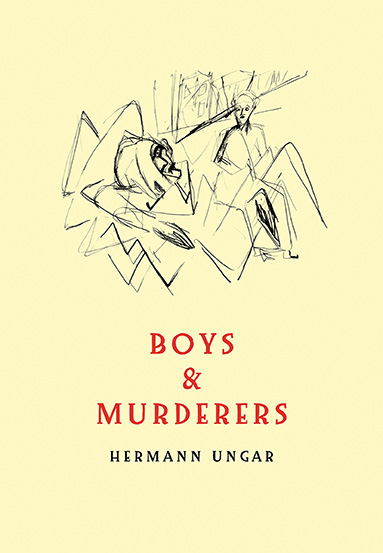
boys & murderers
Collected Short Fiction
by Hermann Ungar
translated from the German by Isabel Fargo Cole
preface by Thomas Mann
cover art and frontispiece by Otto Gutfreund
Boys & Murderers is the first complete collection in English translation of Hermann Ungar’s novellas and
stories. A writer of unique talent whose dark analyses of the human psyche was admired by Thomas Mann, who provides a preface, Ungar’s
prose is often grotesque and comical, if not occasionally horrific. Much like his highly acclaimed novel The Maimed, he delves
here into the depravities of heart and delusions of mind, the settings ranging from Prague to his hometown of Boskovice in Moravia
to much further afield. Although his life was cut short by illness, and his work was forgotten for decades, Ungar can rightfully be
located in that illustrious tradition of Prague German Jewish writers who came of age during the Austro-Hungarian Empire.

Every horror is a social critique for Ungar. Through his fiction, he coyly argues that everything would be easier if preordained—if every step forward did not have the potential
of being a misstep. That would be freedom. Then life would be pleasant, even enjoyable — granted, that is, you are bourgeois, which sadly none of his protagonists are. The world is a grand theatre
and some actors have been given more appealing roles. |
— Mieke Chew, Music & Literature
|
In the two novellas "Boys & Murderers" [Ungar] demonstrates an almost disconcerting mastery. Here, in utterly sharp,
utterly clear, almost violently naked language, the author relates two fates with an intensity equaled by few of today's
luminaries. Unyielding, steely as a screw, a cruel psychology bores its way into people, down to the innermost core of their
being: you falter, you shudder to read on, but with the relentless grip of a man on fire he thrusts you inexorably into his
narrative will, not releasing you until the final page. I rank this little book among the most powerful to have emerged from
Austria or Germany in recent years. From now on the greatest hopes, the highest expectations, will be pinned to this new name. |
— Stefan Zweig
|
Ungar's tone is sinister, even disturbing, and when we embark on reading one we never know what strange people we are going
to encounter there. |
— A Common Reader
|
As with his notorious first novel, the stories in Boys & Murderers plumb the
depths of desperation and depravity, suggesting both Robert Walser's sense of the abject
and Franz Kafka's brutal irony.
|
— Rain Taxi Review of Books
|
[T]aken as a whole, there is much to be admired in this volume, and much in keeping with Ungar's novels.
Boys & Murderers strengthens the case for Ungar being an unjustly neglected writer. |
— Brian Evenson, Review of Contemporary Fiction
|
Ungar's use of language in this remarkable translation paints the reader a portrait of the grim realities of the
lives of those who often pass us by in the streets as invisible, tortured beings. This collection represents the
work of a man whose literary talent has remained unknown to most of the world until now. It is a spectacular
example of literature that had its own limited time on Earth, the German-Jewish literature of the Czech lands. |
— Slavic and East European Journal
|
Kafka is often suggested as a reference point to Ungar's work, but that is not right: the crazed Old Testament
morality to some of the writing reminds one more of Flannery O'Connor. Ungar is convinced of our fated lives.
We struggle to maintain order and propriety but, for his characters, the struggle is inevitably doomed. |
— Mark Thwaite, Times Literary Supplement
|
The perpetual humiliation machine in Ungar's fiction never winds down; it blocks both pleasure and resolution,
ratcheting ever further into horror ... In [the] minor arena of sexual horror, Ungar is unsurpassable. |
— Diana George, Chicago Review
|
Its title less Freudian than factual, a bald statement of theme, Boys & Murderers is obsessional literature,
harrowing and pitiless. In its first story, "A Man and a Maid," a boy leaves his orphanage for America, where he
endeavors to make a fortune, only to return to his Moravian town (based on Ungar's native Boskovice) to enslave the
orphanage's charwoman, whose sexuality so preoccupied his childhood. Other stories similarly confront a world in
adolescent decay, a modernity beset with the basest desires: Ungar's people are almost invariably nymphomaniacs and
killers, soldier-drunkards humored by the occasional barbering hunchback. In these pages, there's little history to
parse, and hardly any psychology. Topos matters little; the names may change, but we stay the same — our demons
follow us everywhere.
|
— Forward
|
[A] masterpiece, with such a wealth of psychological relationships, symbolism, harrowing experience, comedy and misery,
bold moral statements and artfully evoked mystery that one has this feeling: this comes from a fullness; here is a talent
that musters its forces for deeds that will make a stir . . . extraordinary artistic courage and inspiration, a vision that
has left its mark on me forever. |
— Thomas Mann
|
For all its psychological horror, Ungar's writing nevertheless unearths certain truths about the human condition that
manage to seriously affect the reader's waking dreams. Boys & Murderers is a book for people who dream while they're
awake, who aren't afraid to name their most personal fears. |
— Think *again
|
|
|
 |
|
ISBN 9788086264257
251 pp., 135 x 195 mm
softcover with flaps
1 b/w illustration
novellas • stories
publication:
August 2006
order from:
Wordery
Bookshops
Indiebound
Bookshop.org
Amazon US
Amazon UK
Central Books
e-book
Amazon US
Amazon UK
Amazon Canada
Amazon Germany
Amazon India
Amazon Japan
iTunes Bookstore
Kobo
|