| |

Read about Jan Švankmajer here
Read an interview with the translator here
also by the author:
DVDs:
Collected Shorts
Faust
Little Otik
|
|
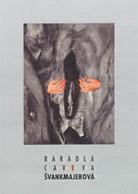
baradla cave
by Eva Švankmajerová
translated from the Czech by Gwendolyn Albert
illustrated by the author and Jan Švankmajer
Baradla Cave is a novel by the Czech Surrealist Eva Švankmajerová,
who is perhaps best known for her paintings and collaboration
with her husband Jan Švankmajer on a number of films. Originally
published in samizdat in the 1980s, the book was republished in
1995 by Edice Analogon, having lost none of the force of its social
critique and wit. Baradla is a living organism, both place (Prague)
and person (a woman), and the novel explores maternity and femininity
while offering a satirical look at the overweening mother-state
and consumer society. As the language shifts between psuedo-scientific
jargon, common vernacular, and metaphoric stream, scenes of episodic
sexual violence alternate with humorous reflections on various
ingrained habits and customs. Švankmajerová's sense of the absurd
is seemingly without limit, fingering here practically everything
having to do with modern urban existence: drug addiction, murder,
sex crimes, corruption, and dysfunctional family relationships.

What others say:
Eva's Baradla is a work that will
live a long life. |
— Vratislav Effenberger
|
How long must English-language readers wait for someone to translate her. |
— Penelope Rosemont (editor
of Surrealist Women)
|
Svankmajerova's mode of literary expression
is in like manner heavily visual in character and, like
her paintings, the artist's writing reflects a delicate
balance of reality and irony, humor and terror. . . . The
novel is an astute and satirical — however troubling
— account of late 20th-century society. |
— Prager
Zeitung
|
Svankmajerova's style of surrealism can be daunting at first. The stream-of-consciousness thoughts of one character often wind and wend their way into
the mind of another. Whether that mind belongs to a man, a woman, or a cave
is sometimes for the reader to decide. But her use of surrealism to convey
non-life under totalitarianism pre-dates the same technique visible in
Victor Pelevin's novel The Clay Machine Gun. Both works describe a
crumbling society speeding towards America's consumer lifestyle, with large
Japanese corporations in the driving seat. |
— Blue Ear
|
|
|
 |
|
ISBN 9788090217171
140 pp.
14.5 x 20.5 cm
softcover with flaps
smythe sewn
5 full-color illustrations
fiction : novel
out of stock
new edition here
|